Last Updated: 20 November 2026
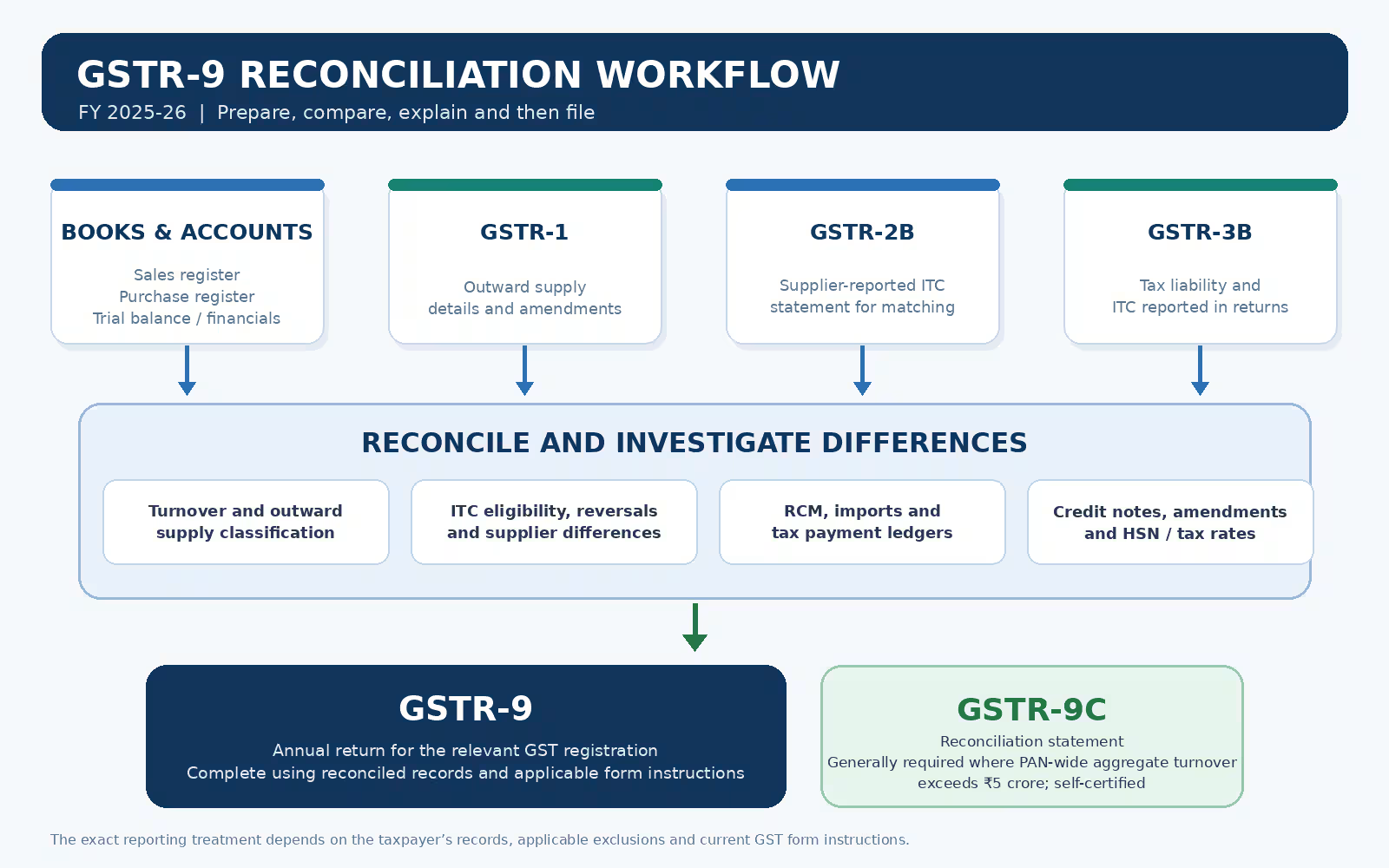
Filing GSTR-9 is not just about downloading auto-populated figures from the GST portal and submitting an annual return. Businesses must reconcile their sales, purchases, Input Tax Credit (ITC), tax payments and financial statements before finalising their annual GST compliance.
For FY 2025-26, the normal due date for filing GSTR-9 and applicable GSTR-9C is 31 December 2026. However, businesses should begin their reconciliation well before the deadline.
Differences between GSTR-1, GSTR-3B, GSTR-2B and books of accounts can indicate unreported sales, excess ITC claims, missed eligible credits, incorrect tax payments or accounting discrepancies.
A properly prepared GST reconciliation helps identify these issues before filing the annual return.
This guide by C P Agrawal & Associates, Chartered Accountants, explains nine important reconciliations businesses should complete, who needs to file GSTR-9 and GSTR-9C for FY 2025-26, the latest reporting changes and how professional GST reconciliation assistance can help businesses avoid compliance mistakes.
Quick Answer: What Should Be Reconciled Before Filing GSTR-9 for FY 2025-26?
Before filing GSTR-9, businesses should reconcile their:
Sales register with GSTR-1.
GSTR-1 with GSTR-3B.
Financial statements with GST turnover.
Purchase register with GSTR-2B.
ITC claimed in GSTR-3B with eligible ITC.
Reverse charge transactions and import-related ITC.
Credit notes, debit notes and amendments.
GST liability with actual tax payments.
HSN-wise reporting, applicable tax rates and GSTR-9C figures, wherever required.
Important GST annual return dates for FY 2025-26:
| Particulars | Applicable date |
|---|---|
| ITC claiming deadline under Section 16(4) | 30 November 2026 or filing of the relevant annual return, whichever is earlier |
| GSTR-9 filing due date | 31 December 2026 |
| GSTR-9C filing due date, where applicable | 31 December 2026 |
The above dates reflect the normal statutory position as of 20 November 2026 and are subject to any subsequent government notification extending the deadlines.
1. Who Needs to File GSTR-9 and GSTR-9C for FY 2025-26?
GSTR-9 is the annual GST return that consolidates the information reported by a registered taxpayer during the financial year.
It includes details of outward supplies, inward supplies, ITC availed, tax liability, tax paid and other prescribed particulars.
GSTR-9C is a reconciliation statement that explains differences between the figures reported in the annual GST return and the corresponding financial statement information.
The filing requirements depend on the aggregate turnover of the taxpayer.
GSTR-9 applicability based on turnover
| Aggregate turnover in FY 2025-26 | Annual return requirement |
|---|---|
| Up to ₹2 crore | Exempt from GSTR-9 filing |
| Above ₹2 crore and up to ₹5 crore | GSTR-9 |
| Above ₹5 crore | GSTR-9 and GSTR-9C |
Latest update: Notification No. 15/2025-Central Tax dated 17 September 2025
The government has exempted registered persons having aggregate turnover up to ₹2 crore in a financial year from filing the annual return from FY 2024-25 onwards.
Therefore, eligible regular taxpayers with turnover up to ₹2 crore are also covered by this exemption for FY 2025-26.
Who needs to file GSTR-9C?
Under Rule 80(3) of the CGST Rules, registered persons whose aggregate turnover exceeds ₹5 crore during the financial year must furnish GSTR-9C along with GSTR-9.
GSTR-9C is a self-certified reconciliation statement. A separate certification by a Chartered Accountant or Cost Accountant is not mandatory under the present GST provisions.
The removal of the earlier GST audit requirement does not eliminate the requirement to prepare and furnish GSTR-9C when the prescribed turnover threshold is crossed.
Is the turnover threshold calculated GSTIN-wise or PAN-wise?
Aggregate turnover is calculated on an all-India basis for persons having the same PAN.
For example, suppose a company has the following GST registrations:
| Registration | Annual turnover |
|---|---|
| Delhi GSTIN | ₹3 crore |
| Uttar Pradesh GSTIN | ₹2 crore |
| Maharashtra GSTIN | ₹1.50 crore |
| Total aggregate turnover | ₹6.50 crore |
The aggregate turnover is ₹6.50 crore, not ₹3 crore or ₹2 crore individually.
Therefore, the applicable annual return requirements must be evaluated using the PAN-wide aggregate turnover. Annual returns are filed separately for the relevant GST registrations.
Aggregate turnover generally includes taxable supplies, exempt supplies, exports and inter-State supplies, while excluding GST and inward supplies taxable under reverse charge, as prescribed under Section 2(6) of the CGST Act.
Note: Input Service Distributors, specified TDS/TCS deductors and collectors, casual taxable persons and non-resident taxable persons are covered by the exclusions in Section 44. Composition taxpayers should follow the separate annual return requirements under GSTR-4 rather than assuming that the regular GSTR-9 provisions apply.
2. What Is the Due Date for GSTR-9 and GSTR-9C for FY 2025-26?
Under Section 44 of the CGST Act read with Rule 80 of the CGST Rules, the normal due date for filing the annual return is 31 December following the end of the relevant financial year.
Accordingly:
The normal due date for GSTR-9 and applicable GSTR-9C for FY 2025-26 is 31 December 2026.
GSTN enabled the FY 2025-26 GSTR-9 and GSTR-9C filing facility on the GST portal from 8 October 2026.
According to the GSTN advisory dated 13 October 2026, taxpayers must file all applicable GSTR-1 and GSTR-3B returns for FY 2025-26 to enable the annual return filing facility.
Businesses should therefore complete their pending periodic returns before attempting to file GSTR-9.
Important: The 30 November 2026 ITC Deadline
Businesses should pay particular attention to Section 16(4) of the CGST Act.
Generally, ITC relating to invoices or debit notes pertaining to FY 2025-26 cannot be claimed after:
30 November 2026; or
The date of furnishing the relevant annual return,
whichever is earlier.
For example, if a taxpayer files GSTR-9 on 25 November 2026, the annual return filing date becomes the earlier cut-off under Section 16(4).
Therefore, before filing GSTR-9, businesses should check whether any eligible ITC relating to FY 2025-26 remains to be claimed in the permitted period.
This is particularly important where:
Purchase invoices have not been considered for ITC.
Suppliers have not uploaded eligible invoices.
GSTR-2B and purchase register figures do not match.
Eligible credit is pending due to accounting omissions.
Import-related ITC has not been properly recorded.
Important: GSTR-9 is not a mechanism for claiming fresh ITC after the statutory deadline. Eligible ITC must be claimed through the prescribed return within the applicable time limit.
3. Nine Important Reconciliations to Complete Before Filing GSTR-9
This is the most important part of the annual return preparation process.
Businesses may have filed every monthly or quarterly GST return correctly but still discover differences when comparing annual accounting records with GST portal data.
The following nine reconciliations can help identify such differences.
Reconciliation 1: Sales Register vs GSTR-1
The first step is to compare the annual sales register maintained in the accounting software with the outward supplies reported in GSTR-1.
The reconciliation should cover:
B2B sales.
B2C sales.
Export invoices.
Supplies to SEZ units and developers.
Credit notes and debit notes.
Exempt and nil-rated supplies.
Advances, wherever relevant.
Amendments reported during the year.
Supplies covered under Section 9(5), where applicable.
Practical example:
Suppose a business records annual outward supplies of ₹1.20 crore in its sales register, whereas its reconciled GSTR-1 figures amount to ₹1.17 crore.
There is a difference of ₹3 lakh.
The business should identify whether the difference relates to:
Sales invoices recorded in the books but omitted from GSTR-1.
Timing differences.
Incorrectly reported credit notes.
Amendments made in subsequent tax periods.
Transactions requiring a different GST classification.
The difference should be explained and supported by the underlying invoices and accounting records.
Reconciliation 2: GSTR-1 vs GSTR-3B
GSTR-1 reports details of outward supplies, whereas GSTR-3B is the summary return through which the taxpayer declares tax liability and discharges applicable tax.
The outward supply liability reported in GSTR-1 should be reconciled with the matching figures declared in GSTR-3B.
Common reasons for differences include:
Invoices reported in the wrong month.
Incorrect GST rates.
Credit notes not adjusted correctly.
Amendments made in subsequent returns.
Advances and subsequent adjustments.
Incorrect inter-State or intra-State classification.
Omitted taxable outward supplies.
Businesses should separately examine IGST, CGST, SGST and cess, wherever applicable.
A mismatch between GSTR-1 and GSTR-3B should never be treated as automatically payable tax. The underlying transactions and reporting periods must first be examined.
Reconciliation 3: Books of Accounts vs GST Turnover
The turnover disclosed in the financial statements may not always match the turnover reported in GST returns.
This is one of the most important checks for companies, LLPs and businesses maintaining complete accounting records.
Differences may arise because of:
Sale of fixed assets.
Exempt income.
Interest income.
Export revenue.
Advances received.
Branch or stock transfers.
Credit notes and debit notes.
Timing differences.
Other income requiring separate GST examination.
Not every accounting receipt or income automatically qualifies as a taxable supply under GST.
Similarly, certain supplies may have different accounting and GST reporting treatment.
Illustrative reconciliation:
| Particulars | Amount |
|---|---|
| Revenue as per books of accounts | ₹1,50,00,000 |
| Less: Accounting income not forming part of GST turnover | ₹5,00,000 |
| Add: Relevant GST adjustments | ₹2,00,000 |
| Reconciled turnover | ₹1,47,00,000 |
The above figures are only an illustration. Every adjustment must be supported by the nature of the transaction and the applicable GST provisions.
For taxpayers required to file GSTR-9C, this reconciliation is particularly important because the statement explains differences between the GST annual return and the corresponding financial statement figures.
Reconciliation 4: Purchase Register vs GSTR-2B
Input Tax Credit is another major area requiring detailed examination before annual return filing.
Businesses should compare their purchase register with GSTR-2B to identify:
Purchase invoices recorded in books but missing from GSTR-2B.
Invoices appearing in GSTR-2B but not recorded in books.
Incorrect supplier GSTINs.
Duplicate invoice entries.
Credit notes not considered correctly.
Differences in taxable values and GST amounts.
Invoices appearing in different reporting periods.
Example:
A company has recorded purchase invoices carrying GST of ₹18 lakh in its accounting software.
However, its purchase register and GSTR-2B reconciliation indicates only ₹16.80 lakh of corresponding credit.
The difference of ₹1.20 lakh requires investigation.
Possible reasons include:
Suppliers not uploading invoices.
Incorrect invoice details.
Accounting omissions.
Differences in reporting periods.
Ineligible or restricted credits.
GSTR-2B is an important source for reconciliation, but the appearance of an invoice in GSTR-2B does not automatically establish ITC eligibility.
The conditions under Section 16 and restrictions under Section 17 must also be examined.
For more information, businesses can refer to our guide on GST Invoice Management System (IMS) and GSTR-2B data management.
Reconciliation 5: ITC Claimed in GSTR-3B vs Eligible ITC
After reconciling purchases with GSTR-2B, businesses should examine the actual ITC claimed in GSTR-3B.
The reconciliation should identify:
Excess ITC claimed.
Eligible ITC not claimed.
Ineligible ITC.
Blocked credit under Section 17(5).
ITC reversals.
Common credit requiring proportionate reversal.
Credit relating to earlier financial years.
Re-credit and reclaim transactions.
For example, certain motor vehicle expenses, food and beverage expenses and personal expenses may fall under restrictions prescribed in Section 17(5), subject to the applicable exceptions.
Similarly, common ITC attributable to taxable and exempt supplies may require proportionate reversal under Rule 42 or Rule 43.
Why is this important?
An incorrect ITC claim may result in interest, reversal requirements or further GST compliance issues.
Businesses should therefore prepare a proper reconciliation of eligible, ineligible, reversed and claimed credit rather than relying entirely on the auto-populated figures.
Reconciliation 6: Reverse Charge Mechanism and Import-Related ITC
Reverse Charge Mechanism (RCM) is another area where businesses may overlook their GST liabilities.
Under RCM, the recipient is responsible for paying GST on specified categories of supplies covered by the relevant provisions and notifications.
Businesses should review their expense ledgers and identify transactions that may attract reverse charge.
The review may include:
Legal and professional services, wherever applicable.
Goods Transport Agency services, where RCM applies.
Import of services.
Specified renting transactions.
Other notified categories.
Import of goods.
Relevant Input Service Distributor credits.
For RCM transactions, the liability declared in GSTR-3B should be reconciled with the actual payment of tax.
Eligible ITC claimed on RCM transactions should also be examined separately.
Import-related ITC should be checked against Bills of Entry and applicable customs documentation.
FY 2025-26 reporting consideration:
Businesses should also pay attention to Table 8H1 of GSTR-9, which records IGST credit on import of goods pertaining to the financial year but availed in the subsequent financial year, as per the applicable form instructions.
This is particularly important for businesses importing goods near the financial year-end.
Reconciliation 7: Credit Notes, Debit Notes and Amendments
Credit notes, debit notes and amendments can significantly affect annual turnover and tax reconciliation.
Businesses should verify that:
GST credit notes have been recorded correctly.
Corresponding GST adjustments have been reported.
Debit notes have been accounted for correctly.
Amendments made in subsequent returns have been considered.
Transactions relating to previous financial years have been classified correctly.
A commercial or financial credit note without a corresponding GST adjustment should not automatically be treated as a reduction in GST liability.
The applicable conditions and statutory timelines under Section 34 of the CGST Act must be examined before reducing output tax liability.
Similarly, amendments relating to previous financial years should be reported in the appropriate annual-return tables based on the relevant financial year and filing period.
Businesses should not assume that an adjustment can always be made simply by entering it in GSTR-9.
Reconciliation 8: GST Liability vs Tax Payments
The annual GST liability should be compared with the tax actually discharged during the financial year.
This reconciliation should include:
Output tax liability reported in GSTR-3B.
Tax discharged through the electronic credit ledger.
Tax paid through the electronic cash ledger.
Challans and cash deposits.
Interest paid.
Late fees.
Additional tax paid through DRC-03.
Refunds and outstanding demands, wherever relevant.
For businesses that have made voluntary payments or additional tax payments through DRC-03, the corresponding payment records and the reason for payment should be examined.
A difference between the declared liability and amount paid should be investigated before filing the annual return.
Where additional tax liability is identified, the appropriate payment and reporting mechanism must be determined according to the nature of the discrepancy and applicable provisions.
Reconciliation 9: HSN Summary, GST Rate Changes and GSTR-9C
The final review should cover HSN/SAC classification, applicable GST rates and financial statement reconciliation.
FY 2025-26 includes GST rate changes effective from 22 September 2025 for affected goods and services.
Consequently, a business dealing in affected products or services should verify whether transactions before and after the applicable effective date were reported using the correct tax rates.
The review should include:
HSN and SAC classification.
Rate-wise taxable value.
Applicable CGST, SGST, IGST and cess.
Credit notes and debit notes affecting tax rates.
HSN-wise outward supplies.
Financial statement reconciliation.
GSTR-9C reporting, wherever applicable.
GSTR-9C consideration
Where GSTR-9C is applicable, businesses should reconcile the GST turnover with the annual financial statements and explain material differences.
The reconciliation should be supported by proper working papers rather than unexplained balancing figures.
4. Important GSTR-9 and GSTR-9C Form Changes for FY 2025-26
Businesses should not blindly copy the reporting approach followed in previous financial years.
Two notifications are particularly relevant to annual return preparation.
A. Notification No. 13/2025-Central Tax dated 17 September 2025
This notification amended the GSTR-9 and GSTR-9C forms and their instructions, with relevant changes applicable from FY 2024-25 onwards.
Some important reporting changes include:
Table 6A1 and Table 6A2 for identifying ITC relating to previous years and net ITC pertaining to the current financial year.
Table 8H1 for import IGST credit availed in the subsequent financial year.
Changes to the treatment of ITC reported in Part IV.
Revised reporting of certain transactions and adjustments made in subsequent financial years.
Changes relating to additional liability payment and reconciliation disclosures.
For FY 2025-26, businesses should use the applicable updated GSTR-9 and GSTR-9C formats rather than relying on older Excel templates or previous-year reporting assumptions.
B. Notification No. 05/2026-Central Tax dated 26 October 2026
The Central Goods and Services Tax (Amendment) Rules, 2026 extended specified reporting options in the annual return form instructions to FY 2025-26 onwards.
These include specified table instructions relating to:
GSTR-9:
Tables 5D, 5E and 5F.
Tables 5H, 5I, 5J and 5K.
Tables 6B, 6C and 6D.
Specified disclosures in Tables 15 and 16.
Tables 17 and 18.
GSTR-9C:
Specified reconciliation disclosures under Tables 5B to 5N.
Table 14.
These changes extend particular simplified or optional reporting treatments. They do not eliminate the general requirement to reconcile the annual return with underlying books and supporting documents.
The exact option available must be checked against the relevant table instructions and the taxpayer’s facts.
C. GST Rate Changes During FY 2025-26
Another important consideration is the GST rate rationalisation implemented from 22 September 2025 for affected categories of goods and services.
Businesses that deal in products or services whose GST rates changed during the financial year should review the following:
Invoice date and applicable time-of-supply provisions.
Correct HSN/SAC classification.
Rate applicable to each transaction.
Credit and debit note adjustments.
Tax paid under the correct tax heads.
A business may have transactions attracting different GST rates within the same financial year. Therefore, the annual return should be prepared after checking the applicable rate notifications rather than applying one rate to the entire year.
5. Can GSTR-9 Be Filed Using Only Auto-Populated GST Portal Data?
No. Auto-populated information should not be treated as a substitute for proper reconciliation.
The GST portal uses previously filed returns and other available information to populate relevant fields.
However, auto-population does not establish that:
All sales have been correctly recorded.
All eligible ITC has been claimed.
Ineligible ITC has been reversed.
Reverse charge liabilities have been discharged.
Books of accounts agree with GST returns.
All amendments and credit notes have been properly considered.
For example, a business may have filed every GSTR-3B correctly but still discover a difference between its annual purchase register and GSTR-2B.
Similarly, accounting entries may require examination before they can be correctly classified for GST purposes.
Another important consideration is that GSTR-9 does not have a normal revision facility after filing.
Therefore, businesses should carefully review the annual return and supporting reconciliations before final submission.
6. Documents Required for GSTR-9 and GSTR-9C Filing
Preparing documents in advance can make the annual return process more efficient and reduce avoidable delays.
Businesses that have changed accountants and are unable to obtain their previous GST returns, Tally backups or accounting records can refer to our guide on recovering GST records and filing details from a previous accountant.
The following records should generally be arranged:
| Document | Purpose |
|---|---|
| Sales register | Outward supply reconciliation |
| Purchase register | ITC and purchase reconciliation |
| GSTR-1 | Verification of outward supplies |
| GSTR-3B | Verification of tax liability and ITC |
| GSTR-2B | Input Tax Credit reconciliation |
| Trial balance | Verification of accounting balances |
| Profit and Loss Account | Annual turnover and expense review |
| Balance Sheet | Financial statement reconciliation |
| Credit notes and debit notes | Adjustment verification |
| E-invoice data | Additional sales verification, where applicable |
| E-way bill data | Transaction cross-checks, where relevant |
| Bills of Entry | Import-related ITC verification |
| RCM workings | Reverse charge liability and ITC |
| Electronic cash ledger | Cash payment verification |
| Electronic credit ledger | ITC utilisation verification |
| Electronic liability register | GST liability reconciliation |
| DRC-03 challans | Additional tax payment verification |
| Previous annual returns | Review of earlier-year adjustments |
For GSTR-9C, the relevant annual financial statements and supporting reconciliation workings should also be maintained.
The exact documentation requirement will depend on the nature of the business, its GST registrations and the applicable reporting requirements.
7. Common Mistakes Businesses Should Avoid While Filing GSTR-9
Some of the most common annual GST return mistakes include:
Accepting auto-populated figures without comparing them with books of accounts.
Treating every GSTR-2B entry as automatically eligible ITC.
Ignoring missing supplier invoices.
Not checking blocked ITC under Section 17(5).
Overlooking reverse charge liability on applicable expenses.
Incorrect treatment of credit notes and debit notes.
Using incorrect HSN classifications or GST rates.
Confusing accounting turnover with GST aggregate turnover.
Not reconciling tax liability with electronic ledgers.
Filing GSTR-9 without reviewing the final workings.
These mistakes can lead to incorrect disclosures, additional tax exposure, interest liabilities and complications during departmental scrutiny.
A properly conducted reconciliation exercise helps businesses identify differences before filing.
Where GST discrepancies have already resulted in a departmental notice, businesses should understand the appropriate response procedure. Read our detailed guide on how to reply to a GST notice online in 2026.
8. How C P Agrawal & Associates Can Help With GSTR-9 and GSTR-9C Filing
Preparing an annual GST return requires more than entering figures into an online form.
Businesses need proper accounting records, invoice-level information, ITC reconciliation and an understanding of the applicable GST provisions.
C P Agrawal & Associates is a Chartered Accountancy firm established in Delhi on 9 May 2001, providing taxation, accounting, GST, auditing and corporate compliance services to businesses across India.
Our team can assist businesses with GSTR-9 and GSTR-9C-related work, including:
1. GST Annual Return Review
Reviewing previously filed GSTR-1 and GSTR-3B returns.
Checking applicable filing periods and pending returns.
Examining GST registration-wise turnover.
Identifying differences between books and GST returns.
2. Input Tax Credit Reconciliation
GSTR-2B versus purchase register reconciliation.
GSTR-3B versus eligible ITC review.
Examination of blocked ITC and reversals.
Review of reverse charge-related ITC.
Import-related ITC verification.
Identification of supplier-related discrepancies.
3. Turnover and Tax Liability Reconciliation
Sales register versus GSTR-1.
GSTR-1 versus GSTR-3B.
Books of accounts versus GST turnover.
Credit note and debit note reconciliation.
Review of tax payments and electronic ledgers.
4. GSTR-9 and GSTR-9C Preparation Assistance
Preparation and review of annual return workings.
Examination of the latest applicable reporting requirements.
Reconciliation of annual financial statements with GST returns.
Assistance with GSTR-9C preparation and self-certification requirements.
Assistance with annual return filing and related compliance.
5. Ongoing GST and Accounting Support
Regular bookkeeping and GST reconciliation are equally important for maintaining accurate records throughout the financial year. Businesses can learn more about affordable GST return filing and outsourced bookkeeping services.
Businesses looking for regular professional assistance can also engage support for:
Monthly GSTR-1 and GSTR-3B filing.
GST reconciliation.
Bookkeeping and accounting.
TDS compliance.
Taxation and statutory compliance.
Management reporting and financial record maintenance.
Businesses requiring regular accounting support may also explore our GST filing and outsourced bookkeeping services.
Our objective is to help businesses maintain organised financial records and a reliable GST compliance system throughout the year rather than discovering differences only when the annual return is due.
Need Professional Assistance With GSTR-9 or GST Reconciliation?
Whether you operate a private limited company, LLP, partnership firm, proprietorship, manufacturing unit, trading business or service-based business, proper GST reconciliation is important before filing your annual return.
C P Agrawal & Associates assists businesses in Delhi, East Delhi and Delhi NCR, while also supporting clients requiring professional GST and accounting services across India.
We can help review your GST returns, accounting records, eligible ITC and annual turnover before filing GSTR-9 and GSTR-9C.
Get your GST annual return and reconciliation reviewed before filing.
C P Agrawal & Associates – Chartered Accountants
🚗 Get Directions on Google Maps
🌐 Explore Our Website
🤝Check Our Professional Services
📞 Call us now at +91 9311221571
Frequently Asked Questions (FAQs)
1. What is the due date for GSTR-9 for FY 2025-26?
The normal due date for filing GSTR-9 for FY 2025-26 is 31 December 2026 under Section 44 of the CGST Act read with Rule 80 of the CGST Rules, unless the government extends the deadline.
2. Is GSTR-9 mandatory for businesses with turnover below ₹2 crore?
No. Notification No. 15/2025-Central Tax exempts registered persons having aggregate turnover up to ₹2 crore from annual return filing from FY 2024-25 onwards, subject to applicable provisions and exclusions.
3. Who needs to file GSTR-9C for FY 2025-26?
Registered persons whose aggregate turnover exceeds ₹5 crore during FY 2025-26 are required to furnish GSTR-9C along with GSTR-9, subject to applicable exclusions.
4. Does GSTR-9C require certification by a Chartered Accountant?
No. GSTR-9C is presently a self-certified reconciliation statement. Separate certification by a CA or CMA is not mandatory under the current GST provisions.
5. Is GSTR-2B sufficient for claiming Input Tax Credit?
No. GSTR-2B is an important source for ITC reconciliation, but the appearance of an invoice in GSTR-2B does not automatically establish ITC eligibility. The conditions under Section 16 and restrictions under Section 17 of the CGST Act must also be examined.
6. What happens if GSTR-1 and GSTR-3B do not match?
Businesses should identify and reconcile differences between the two returns. These may arise from timing differences, amendments, credit notes, incorrect classification or an actual tax liability discrepancy.
7. Can additional GST liability be paid while filing GSTR-9?
Where additional liability is identified, it can be discharged through the prescribed mechanism, including FORM DRC-03 where applicable. The correct treatment depends on the nature of the liability and the relevant GST provisions.
8. Can GSTR-9 be revised after filing?
There is no normal revision facility for GSTR-9 after submission. Businesses should therefore carefully review the return and supporting reconciliations before final filing.
9. What is the last date to claim ITC for FY 2025-26?
Under Section 16(4), the general deadline for claiming eligible ITC relating to FY 2025-26 invoices or debit notes is 30 November 2026 or the date of furnishing the relevant annual return, whichever is earlier.
10. Can a CA firm help with GSTR-9 reconciliation in Delhi NCR?
Yes. A Chartered Accountant firm can assist with reviewing GST returns, reconciling books with GST data, examining ITC eligibility, preparing GSTR-9 and GSTR-9C workings and supporting the annual return filing process.
C P Agrawal & Associates provides GST, accounting and reconciliation assistance to businesses in Delhi, Noida, Delhi NCR and across India.
Important Legal References and Government Resources
The following provisions and notifications should be referred to while preparing GSTR-9 and GSTR-9C: