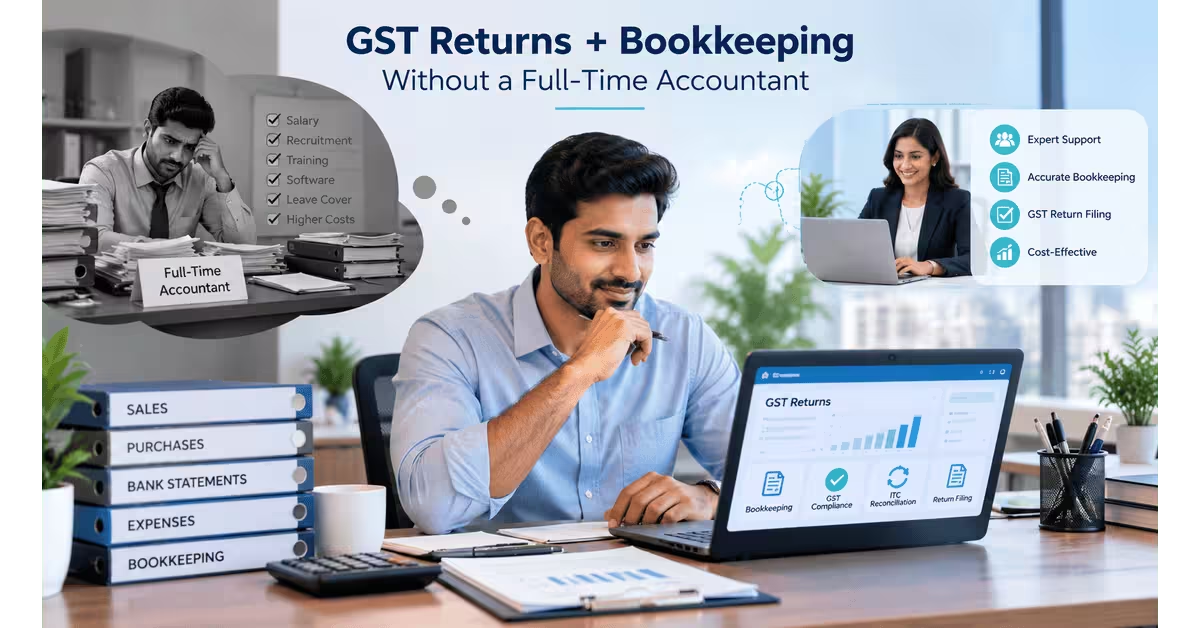
For a small business, hiring a full-time accountant can become a significant recurring expense. Salary is only one part of the cost; recruitment, leave, supervision, software, training and replacement arrangements can also add to the overall accounting overhead.
At the same time, GST compliance cannot simply be ignored.
Businesses need to maintain sales and purchase records, monitor GST liability, reconcile Input Tax Credit (ITC), prepare applicable GST returns and keep their accounting records organised.
So, what is the practical solution?
For many small businesses, outsourcing bookkeeping and GST compliance can be an alternative to maintaining a full-time accountant.
Instead of employing someone permanently, the business can keep routine records internally and engage a CA or professional accounting team to handle bookkeeping, GST reconciliation, return filing and periodic review.
The right arrangement depends on the business’s transaction volume, accounting complexity and compliance requirements.
📌 Quick Answer: Can a Small Business Manage GST Without a Full-Time Accountant?
Yes.
A small business can often manage its accounting and GST requirements through a combination of:
Internal record collection + outsourced bookkeeping + GST return filing + periodic professional review.
This can be suitable where the business has relatively straightforward transactions and does not need an accountant sitting in the office every day.
However, businesses with high transaction volumes, multiple locations, inventory-heavy operations or complex accounting requirements may need dedicated accounting staff.
The objective is not to eliminate professional accounting support. It is to use the right level of support for the size and complexity of the business.
💰 Why Small Businesses Look for Affordable GST and Accounting Solutions
GST filing is only one part of a business’s financial administration.
A small business may have to manage:
Sales invoices
Purchase invoices
Expense records
Bank transactions
Receivables
Payables
GST returns
Input Tax Credit
GSTR-2B reconciliation
Credit and debit notes
E-invoice or e-way bill information, where applicable
Tax payments
GST portal communications
Accounting reports
When all of this work is assigned to a full-time accountant, the business pays for an employee even during periods when accounting workload is relatively low.
Outsourcing allows the business to obtain accounting support based on its actual requirements.
Example
Suppose a small consultancy has:
25 sales invoices per month
A limited number of purchase invoices
A few employees
One GST registration
Relatively simple bank transactions
The business may not need a full-time accountant sitting in the office every day.
It could instead maintain its basic documents and outsource:
Bookkeeping + GST reconciliation + GST return filing + periodic accounting review
A different business with hundreds of daily invoices could require a much more extensive arrangement.
📚 What Is Outsourced Bookkeeping?
Outsourced bookkeeping means engaging an external professional or accounting firm to maintain the business’s financial records instead of employing a full-time in-house bookkeeper or accountant.
Depending on the engagement, outsourced bookkeeping may include:
Recording sales
Recording purchases
Recording business expenses
Bank reconciliation
Customer receivables tracking
Supplier payable tracking
Ledger maintenance
Accounting data organisation
Periodic financial reports
GST-related reconciliation
The business generally provides its invoices, bank statements and transaction information, while the accounting professional processes and reviews the records.
This creates a simple division:
Business owner → Provides accurate information
Accounting professional → Maintains and reviews the books
GST professional → Handles tax compliance and filing
In many small businesses, these functions can be provided by the same professional team.
✅ Why Combine Bookkeeping With GST Filing?
Bookkeeping and GST compliance are closely connected.
Your GST returns are prepared using transaction information. If the books are incomplete or poorly maintained, GST reconciliation becomes more difficult.
For example:
Sales recorded incorrectly
↓
GST liability may be calculated incorrectly
↓
GSTR-1 / GSTR-3B may contain discrepancies
Similarly:
Purchases not recorded properly
↓
ITC reconciliation becomes difficult
↓
GSTR-2B and books may not match
This is why outsourcing only GST filing while completely neglecting bookkeeping can sometimes create unnecessary compliance problems.
A better system is:
Bookkeeping → Reconciliation → GST review → Return filing
🧾 What Bookkeeping Work Can a Small Business Outsource?
The exact scope depends on the business, but outsourced bookkeeping can cover routine financial administration such as:
Sales Accounting
Recording invoices issued to customers and maintaining sales ledgers.
Purchase Accounting
Recording supplier invoices and maintaining purchase records.
Expense Recording
Maintaining records of business expenses and supporting documents.
Bank Reconciliation
Comparing accounting records with bank transactions and identifying differences.
Receivables
Tracking amounts customers still have to pay.
Payables
Monitoring outstanding amounts payable to suppliers.
GST Data Preparation
Organising sales, purchases, expenses and tax information needed for GST compliance.
Periodic Reports
Providing accounting information that helps the business owner understand financial activity.
The advantage is that the business does not necessarily need to employ someone full-time for every one of these activities.
📊 How GST Return Filing Fits Into Outsourced Accounting
GST compliance can then be built around the bookkeeping system.
A practical workflow can look like this:
1. Business generates invoices
↓
2. Purchase and expense documents are collected
↓
3. Bookkeeping records are updated
↓
4. GST data is reviewed
↓
5. GSTR-2B is reconciled where applicable
↓
6. GST liability and return data are checked
↓
7. Applicable GST returns are filed
↓
8. Filed returns and supporting records are retained
This approach creates a continuous compliance process rather than treating GST filing as a last-minute task.
🔄 GSTR-2B Reconciliation: Why Bookkeeping Matters
One of the most important connections between accounting and GST compliance is Input Tax Credit reconciliation.
The GST Portal describes GSTR-2B as an auto-drafted, static ITC statement based on information furnished by suppliers and other relevant sources. It is generated for monthly recipients on the 14th of the succeeding month and for quarterly recipients on the 14th of the month following the quarter.
The GST Portal also advises taxpayers to reconcile GSTR-2B with their own records and books of accounts and to ensure that credit is not claimed twice and reversals are made where required.
This makes proper bookkeeping important.
A basic reconciliation process can identify:
Missing invoices
Duplicate entries
Incorrect GSTINs
Credit notes
Differences between purchase records and portal data
Supplier reporting issues
Other discrepancies requiring investigation
Good bookkeeping therefore supports better GST compliance.
📅 Can the QRMP Scheme Reduce GST Compliance Work?
Eligible small taxpayers may consider the Quarterly Return Monthly Payment (QRMP) Scheme.
According to the GST Portal’s current guidance, taxpayers with aggregate turnover up to ₹5 crore, subject to the applicable conditions, can opt for quarterly GSTR-1 and GSTR-3B filing. Tax can be paid monthly during the first two months of the quarter through the prescribed process.
However, QRMP should not be viewed as an automatic solution for every small business.
Businesses should consider:
Turnover
Transaction volume
B2B customer requirements
ITC timing
Cash-flow considerations
The need for more frequent invoice reporting
Overall compliance requirements
For businesses using QRMP, the GST Portal also provides the optional Invoice Furnishing Facility (IFF) for reporting certain outward supplies during the first two months of a quarter.
So the decision should be based on the business’s actual requirements rather than simply choosing quarterly filing because it appears cheaper.
📝 What Is GSTR-1A and Why Should Businesses Know About It?
Businesses sometimes discover mistakes after GSTR-1 data has been prepared.
The GST Portal currently provides GSTR-1A, an optional facility through which eligible taxpayers can amend certain records or add missed records for the same tax period before filing the corresponding GSTR-3B.
This makes internal review particularly valuable.
Before the GST return is finalised, the business should check:
Sales records → GST rates → Customer GSTINs → Taxable values → Amendments → Credit/debit notes
A proper bookkeeping and review process can identify mistakes before they become more difficult to correct.
💵 Is Outsourced Bookkeeping Cheaper Than Hiring a Full-Time Accountant?
It can be, particularly for businesses with modest or fluctuating accounting workloads.
But there is no universal cost comparison because the price of outsourced accounting depends on the scope of work.
A proper comparison should consider the total cost of an in-house employee.
Full-time accounting model
Salary
Recruitment
Leave and replacement costs
Software
Training
Management time
Employee-related overhead
Outsourced model
Bookkeeping fee
GST compliance fee
Additional professional services where required
The outsourced model may therefore provide a more flexible cost structure for a small business that does not require full-time accounting support.
However, a business should compare providers based on scope, quality, review process and responsiveness, not price alone.
👨💼 Do You Still Need an Accountant if Bookkeeping Is Outsourced?
Not necessarily on a full-time basis.
This is an important distinction.
Outsourcing bookkeeping does not mean eliminating professional accounting oversight.
It means obtaining that support externally.
For example:
Business Owner
Provides:
Sales invoices
Purchase bills
Expense records
Bank statements
Payment information
Other transaction documents
Outsourced Accounting Team
Handles:
Bookkeeping
Ledger maintenance
Bank reconciliation
Financial record organisation
CA / GST Professional
Handles:
GST review
ITC reconciliation
Return preparation
GST filing
Tax compliance review
Complex GST matters
Notice assistance when required
This structure can work well for a small business with straightforward operations.
📋 Monthly GST and Bookkeeping Checklist for Small Businesses
A simple monthly process can prevent a large amount of last-minute work.
| Task | What the Business Should Do |
|---|---|
| 🧾 Sales | Record all sales invoices |
| 🛒 Purchases | Collect and record purchase invoices |
| 💳 Expenses | Organise expense documents |
| 🏦 Bank | Share bank statements and reconcile transactions |
| 👥 Receivables | Update outstanding customer balances |
| 📦 Payables | Update supplier balances |
| 🔄 GSTR-2B | Reconcile ITC data where applicable |
| 📊 GST | Review taxable sales and liability |
| ✅ Returns | Prepare and file applicable GST returns |
| 📁 Records | Save returns, workings and supporting documents |
The more organised the records, the less time a professional needs to spend chasing documents.
⚠️ Common GST and Bookkeeping Mistakes That Increase Costs
Trying to save money by ignoring bookkeeping can eventually make compliance more expensive.
1. Filing GST returns from incomplete records
Missing invoices can result in additional reconciliation work.
2. Mixing personal and business transactions
This makes bookkeeping and financial analysis more difficult.
3. Delaying document submission
Sending several months of invoices together can increase the effort required to reconstruct the accounts.
4. Ignoring GSTR-2B differences
Unresolved ITC mismatches can create avoidable compliance issues.
5. Maintaining records only for GST
Proper accounting records are useful for much more than GST returns.
6. Looking only at filing fees
The cheapest GST filing quote may not include bookkeeping, reconciliation, review or notice assistance.
7. Ignoring GST portal communications
Businesses should regularly monitor notices and other communications rather than discovering them much later.
If your business receives a GST notice, it is important to understand the issue and respond within the applicable timeline. You can also read our guide on how to reply to a GST notice online in 2026 for a step-by-step explanation.
🚨 What Happens When Bookkeeping Is Poor?
Poor bookkeeping can affect more than GST compliance.
It can make it difficult to answer basic business questions such as:
How much money do customers owe me?
How much do I owe suppliers?
What are my actual monthly expenses?
Which invoices are unpaid?
How much GST liability is expected?
How much ITC is available?
Is the business actually making money?
Good bookkeeping turns transactions into usable financial information.
That is why outsourced bookkeeping should not be viewed simply as a data-entry service. It can become part of the business’s overall financial control system.
📈 When Is a Full-Time Accountant More Appropriate?
Outsourcing is not the right solution for every business.
A dedicated accountant may become more appropriate when the business has:
Very high transaction volumes
Multiple GST registrations
Multiple branches
Large inventory
Complex accounts receivable and payable
Payroll and employee accounting requirements
Extensive daily accounting activity
Frequent management reporting requirements
Complex financial controls
The accounting model can evolve as the business grows.
Small business → Outsourced bookkeeping + GST
↓
Growing business → Regular outsourced accounting
↓
Larger operation → Dedicated accounting team or in-house accountant
There is no requirement to choose a permanent accountant simply because the business has obtained GST registration.
🏙️ GST Filing and Bookkeeping for Small Businesses in Delhi and Delhi NCR
Delhi and Delhi NCR have a large number of small traders, consultants, startups, professional firms, retailers, manufacturers, service providers and online businesses.
Their accounting needs can vary significantly.
As businesses grow or move to a new premises, GST registration details may also need to be updated. Businesses can refer to our guide on changing the business address after GST registration to understand the amendment process.
A consultant with a few invoices each month has very different requirements from a retailer with hundreds of daily transactions.
That is why GST filing and bookkeeping in Delhi should be structured around the business’s actual transaction volume and accounting requirements.
For a small Delhi business, outsourced support can potentially cover:
Bookkeeping → Bank reconciliation → GST reconciliation → GST filing → Periodic review
without automatically requiring a full-time accountant.
📚 Can Startups and Freelancers Outsource Bookkeeping and GST Filing?
Yes.
Outsourced bookkeeping can be particularly useful for businesses that are still building their internal administrative team.
For startups and small businesses working remotely or without a traditional office, choosing the right registered office arrangement can also be important for GST compliance. Read our guide on whether a virtual office can be used for GST registration to understand the relevant requirements.
If the business operates from rented premises, it should also ensure that the GST registration documents and address-related requirements are properly handled. See our guide on GST registration for rented premises for more information.
Examples include:
Freelancers
Consultants
Digital agencies
Startups
E-commerce sellers
D2C businesses
Small manufacturers
Traders
Professional service providers
A new business can therefore focus on sales and operations while its accounting and GST records are maintained through an external professional team.
Businesses with unusual or complex transactions should obtain advice based on their specific circumstances.
🤝 How C P Agrawal And Associates Can Help
C P Agrawal And Associates is a Delhi-based Chartered Accountant firm providing accounting, taxation, GST, audit, compliance and business advisory services.
For small businesses, our approach can combine bookkeeping and GST compliance so that business owners do not automatically have to maintain a full-time accounting employee for routine accounting work.
Depending on the business requirement, support can include:
📒 Bookkeeping
Sales and purchase recording
Expense accounting
Ledger maintenance
Bank reconciliation
Receivables and payables tracking
🧾 GST Compliance
GST return preparation
GSTR-1 filing
GSTR-3B filing
GST reconciliation
ITC review
GST compliance support
🔍 Additional Support
GST registration
GST notice assistance
GST audit support
Tax compliance
Periodic accounting review
Our website also provides GST compliance resources covering GST notices, audits, registration and other issues that affect growing businesses.
The goal is not simply to file a GST return.
It is to help maintain an organised accounting and GST compliance system without unnecessarily increasing the business’s permanent staffing cost.
📞 Looking for outsourced bookkeeping and GST filing?
C P Agrawal And Associates can help small businesses manage bookkeeping, GST compliance and related accounting requirements through professional outsourced support.
❓ Frequently Asked Questions
Can I manage GST without hiring a full-time accountant?
Yes. A small business can maintain its routine records internally and outsource bookkeeping, GST reconciliation and return filing to a professional, depending on its requirements.
Is outsourced bookkeeping suitable for small businesses?
It can be suitable where the business has relatively straightforward transactions and does not require an accountant on-site every day.
Can a CA handle both bookkeeping and GST filing?
Yes. A CA firm may provide bookkeeping, GST reconciliation, return filing and other accounting or tax compliance services depending on the engagement.
Is outsourced accounting cheaper than a full-time accountant?
It can provide a lower or more flexible overall cost for some small businesses, but the actual cost depends on transaction volume and the scope of outsourced services.
What is included in outsourced bookkeeping?
Depending on the service arrangement, it may include sales and purchase entries, expense recording, bank reconciliation, ledger maintenance, receivables, payables and financial record organisation.
Can a small business file GST returns itself?
Yes. GST returns are filed electronically through the GST system, but businesses should understand their compliance obligations and may choose professional review where transactions or tax issues are complex.
What is GSTR-2B used for?
GSTR-2B is an auto-drafted ITC statement that taxpayers can use when reviewing eligible Input Tax Credit. The GST Portal advises taxpayers to reconcile it with their own books and records.
Can QRMP reduce GST filing work?
Eligible taxpayers can opt for the QRMP Scheme subject to the applicable conditions. The scheme provides quarterly GSTR-1 and GSTR-3B filing with monthly tax payment during the first two months.
What if my business grows after outsourcing bookkeeping?
The accounting arrangement can be expanded as transaction volume and complexity increase. A business can move from basic outsourced bookkeeping to more extensive accounting support or eventually an in-house accounting team.
Do I need bookkeeping even if my CA files GST returns?
Proper bookkeeping is still important. GST returns are only one part of financial compliance, while accounting records also support tax reporting, financial management, reconciliations and business decision-making.
Can startups in Delhi outsource bookkeeping and GST filing?
Yes. Startups and small businesses in Delhi can outsource accounting and GST compliance based on their transaction volume and business requirements.
Should every small business avoid hiring a full-time accountant?
No. The appropriate accounting model depends on transaction volume, complexity and the business’s operational needs. Some businesses may benefit from an in-house accountant, while others may find outsourced bookkeeping and GST support more suitable.
🎯 Final Takeaway
A small business does not necessarily need to choose between doing all accounting work itself and hiring a full-time accountant.
There is a third option:
Outsource the work that requires professional accounting and GST expertise.
A practical structure can be:
Business owner → Maintains and shares transaction documents
Outsourced accounting team → Handles bookkeeping
CA / GST professional → Reviews GST, reconciles ITC and files returns
This approach can help small businesses maintain organised books, improve GST compliance and control recurring accounting overheads.
For businesses in Delhi and across India, the right solution should be based on transaction volume, accounting complexity and compliance requirements—not simply the desire to pay the lowest filing fee.
Bookkeeping + GST compliance + professional review can provide a scalable accounting model for many small businesses without automatically maintaining a full-time accountant.