
Summary (TL;DR)
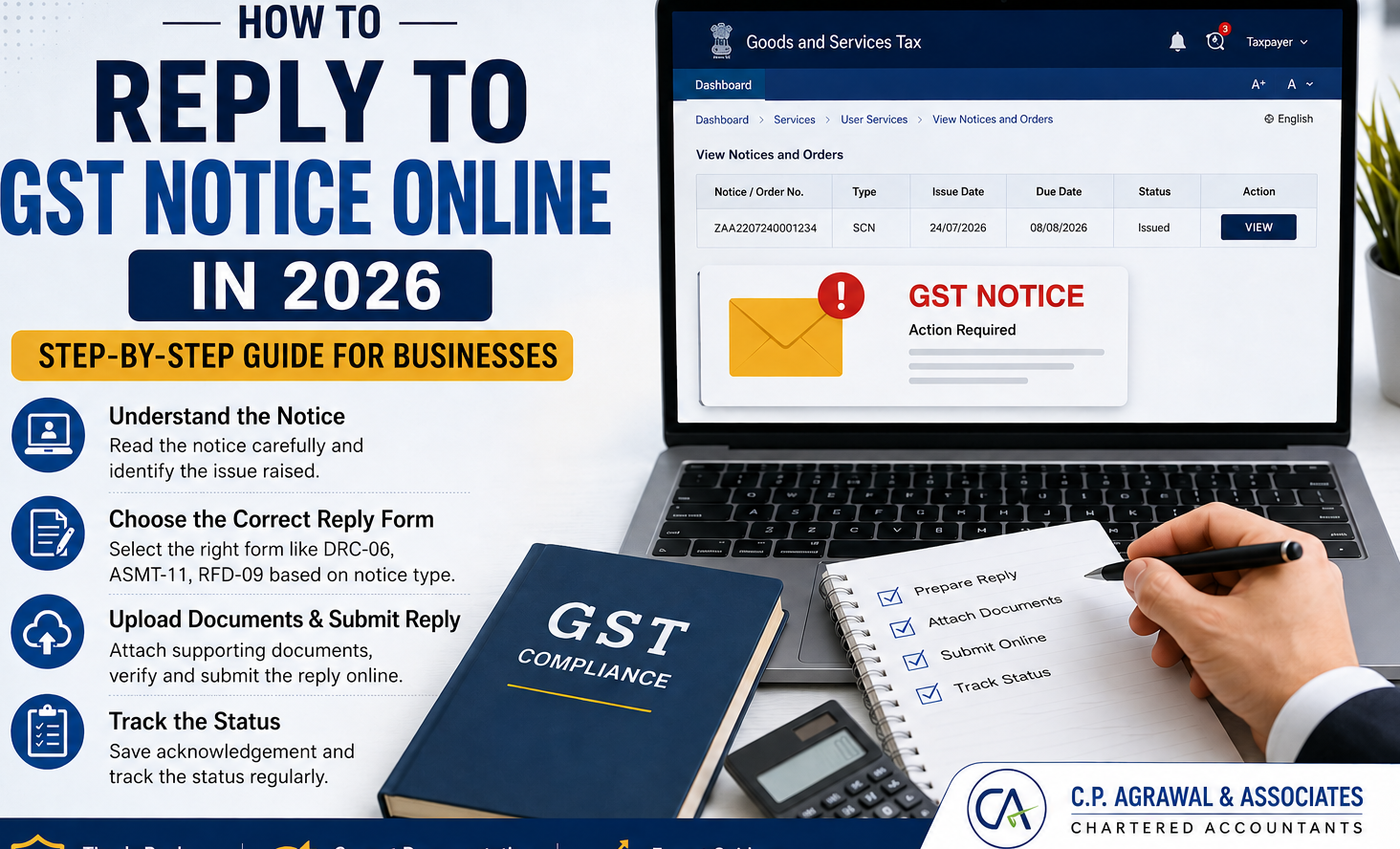
This step-by-step guide outlines the 2026 digital compliance workflow for responding to official GST notices in India. Taxpayers can access, upload supporting documents, and track active proceedings directly through the GST Portal dashboard via Services > User Services > View Notices and Orders…
What is a GST Notice?
A GST notice is an official communication issued by the GST department seeking clarification, documents, explanation, payment, or compliance from a taxpayer.
GST notices may arise due to:
- mismatch in GST returns,
- excess ITC claims,
- non-filing or delayed filing of returns,
- e-way bill discrepancies,
- refund verification,
- scrutiny proceedings,
- registration-related issues,
- audit observations,
- or enforcement proceedings.
The GST portal uses different forms and workflows for different categories of notices. For example:
| Type of Notice | Common Reply Form |
|---|---|
| Scrutiny notice under Section 61 | ASMT-11 |
| Show Cause Notice (SCN) | DRC-06 |
| Refund deficiency / objection notice | RFD-09 |
| Registration clarification notice | REG-related clarification workflow |
Using the wrong response format or submitting incomplete documents can weaken the taxpayer’s position significantly.
Why Businesses Should Never Ignore a GST Notice
Many taxpayers mistakenly assume that small notices can be ignored or handled casually. This is one of the biggest compliance mistakes businesses make.
Ignoring a GST notice may result in:
- tax demand orders,
- penalties,
- interest liability,
- cancellation of GST registration,
- blocking of refunds,
- suspension of ITC,
- departmental scrutiny,
- or further investigation.
In many proceedings, the GST portal restricts replies once the response timeline expires or once the order has already been passed.
Timely action is therefore extremely important.
Step-by-Step Process to Reply to GST Notice Online in 2026
Step 1: Login to GST Portal
Visit the GST portal and log in using the taxpayer credentials or authorised signatory login.
Ensure that:
- the DSC/EVC facility is active,
- the authorised signatory is updated,
- and contact details on the portal are current.
Step 2: Open the GST Notice Section
Navigate to:
Dashboard → Services → User Services → View Notices and Orders
The portal displays notices chronologically, including:
- notice reference number,
- issue date,
- notice type,
- and current status.
Always download the notice PDF immediately.
Step 3: Read the Notice Carefully Before Replying
This is the most critical stage.
Before drafting the response, carefully identify:
- the section under which notice is issued,
- allegations raised,
- reply deadline,
- tax period involved,
- amount disputed,
- and documents requested.
Businesses often make the mistake of replying emotionally or generally without addressing the exact issue raised by the department.
Every allegation mentioned in the notice should be answered point-wise.
Step 4: Identify the Correct Reply Form
Different GST proceedings require different response forms.
Examples include:
DRC-06
Used for replying to:
- Show cause notices,
- tax demand proceedings,
- adjudication proceedings.
ASMT-11
Used for:
- scrutiny assessment notices under Section 61.
RFD-09
Used for:
- refund-related deficiency notices.
Using incorrect forms or incorrect modules may delay the proceedings or make the reply technically defective.
Step 5: Prepare a Proper GST Notice Reply
A professionally drafted GST reply should contain:
1. Background of the Case
Explain:
- nature of business,
- GST registration details,
- relevant transactions,
- and context of the issue.
2. Point-wise Reply
Each observation in the notice should be addressed separately.
Avoid vague replies such as:
- “returns were correctly filed”
- “documents already submitted”
- “difference is due to technical issue”
Instead, provide:
- reconciliations,
- invoice references,
- legal provisions,
- and documentary evidence.
3. Legal Position
Where required, mention:
- relevant GST provisions,
- circulars,
- notifications,
- and judicial precedents.
4. Supporting Documents
Attach:
- invoices,
- return workings,
- ITC reconciliation,
- e-way bills,
- ledger extracts,
- payment proofs,
- agreements,
- bank statements,
- and CA certifications wherever necessary.
Step 6: Upload Documents and Submit Reply
Upload all relevant annexures in readable format.
Before submission:
- verify all attachments,
- check file naming properly,
- review calculations,
- and preview the reply carefully.
Then submit using:
- DSC, or
- EVC authentication.
Always save:
- ARN,
- acknowledgement copy,
- and complete PDF set of reply documents.
Step 7: Track Status After Submission
After filing, the GST portal updates the case status.
Depending on the proceeding, the department may:
- accept the reply,
- issue further clarification,
- schedule hearing,
- issue order,
- or close proceedings.
Businesses should continuously monitor the portal after submission.
Common GST Notices Businesses Receive in 2026
1. GST Return Mismatch Notices
Mismatch between:
- GSTR-1,
- GSTR-3B,
- GSTR-2B,
- e-way bills,
- or annual returns.
2. ITC Mismatch Notices
Issued when:
- supplier has not uploaded invoices,
- excess credit claimed,
- or reconciliation differences exist.
3. Show Cause Notices (SCN)
Typically issued for:
- tax demand,
- excess refund,
- wrongful ITC,
- or alleged non-compliance.
4. GST Registration Cancellation Notices
Common reasons:
- non-filing of returns,
- non-functioning business,
- or suspicious transactions.
5. Refund Objection Notices
Issued during:
- GST refund processing,
- export refund claims,
- inverted duty refunds,
- or accumulated ITC refunds.
Common Mistakes Businesses Make While Replying to GST Notices
1.Missing Reply Deadlines
Late replies weaken the taxpayer’s case significantly.
2.Uploading Incomplete Documents
Missing annexures often trigger further notices.
3.Using Generic Templates
Copied online formats without facts or reconciliations rarely work effectively.
4.Ignoring Legal Position
A factual reply without legal backing may remain weak.
5.Poor Reconciliation
Most GST disputes arise due to improper reconciliations between:
- books,
- returns,
- and portal data.
Professional Tips to Handle GST Notices Effectively
1.Maintain Monthly GST Reconciliation
Regular reconciliation reduces future notices significantly.
2.Keep Vendor Compliance Under Monitoring
Many ITC disputes arise because of vendor defaults.
3.Avoid Panic Replies
Businesses should avoid hurried submissions without review.
4.Consult GST Professionals Early
Early intervention often prevents escalation into adjudication or litigation.
How C.P. Agrawal & Associates Helps Businesses in GST Notice Matters
At C.P. Agrawal & Associates, we help businesses manage GST notices strategically and professionally.
Our services include:
- GST notice review,
- drafting detailed legal replies,
- GST reconciliation support,
- ITC mismatch resolution,
- representation before authorities,
- GST litigation assistance,
- refund notice handling,
- and GST compliance advisory.
We focus on:
- timely response,
- technical accuracy,
- proper documentation,
- and risk minimization.
Whether your business has received a scrutiny notice, SCN, refund objection, or registration-related notice, our team can assist in preparing a strong response.
Conclusion
Replying to a GST notice online in 2026 is no longer just a procedural task — it is a critical compliance exercise that directly impacts tax exposure, working capital, and litigation risk.
Businesses should approach GST notices carefully, maintain proper reconciliations, and ensure that replies are filed professionally with complete supporting evidence.
A well-prepared GST notice reply can often prevent unnecessary penalties, tax demands, and prolonged departmental disputes.
If your business has received a GST notice, timely professional review can make a significant difference.
🚗 Get Directions on Google Maps
🌐 Explore Our Website
📞 Call us now at +91 9311221571
You can reply through the GST portal under:
Services → User Services → View Notices and Orders
The reply form depends on the type of notice issued.
DRC-06 is the form generally used for replying to GST show cause notices and demand proceedings.
Ignoring GST notices may lead to:
- tax demand,
- penalties,
- cancellation of registration,
- ITC blockage,
- or further legal proceedings.
Generally, once submitted, replies cannot easily be revised. Therefore, businesses should carefully review replies before filing.
Common documents include:
- GST returns,
- invoices,
- reconciliations,
- ledgers,
- bank statements,
- e-way bills,
- and supporting agreements.